

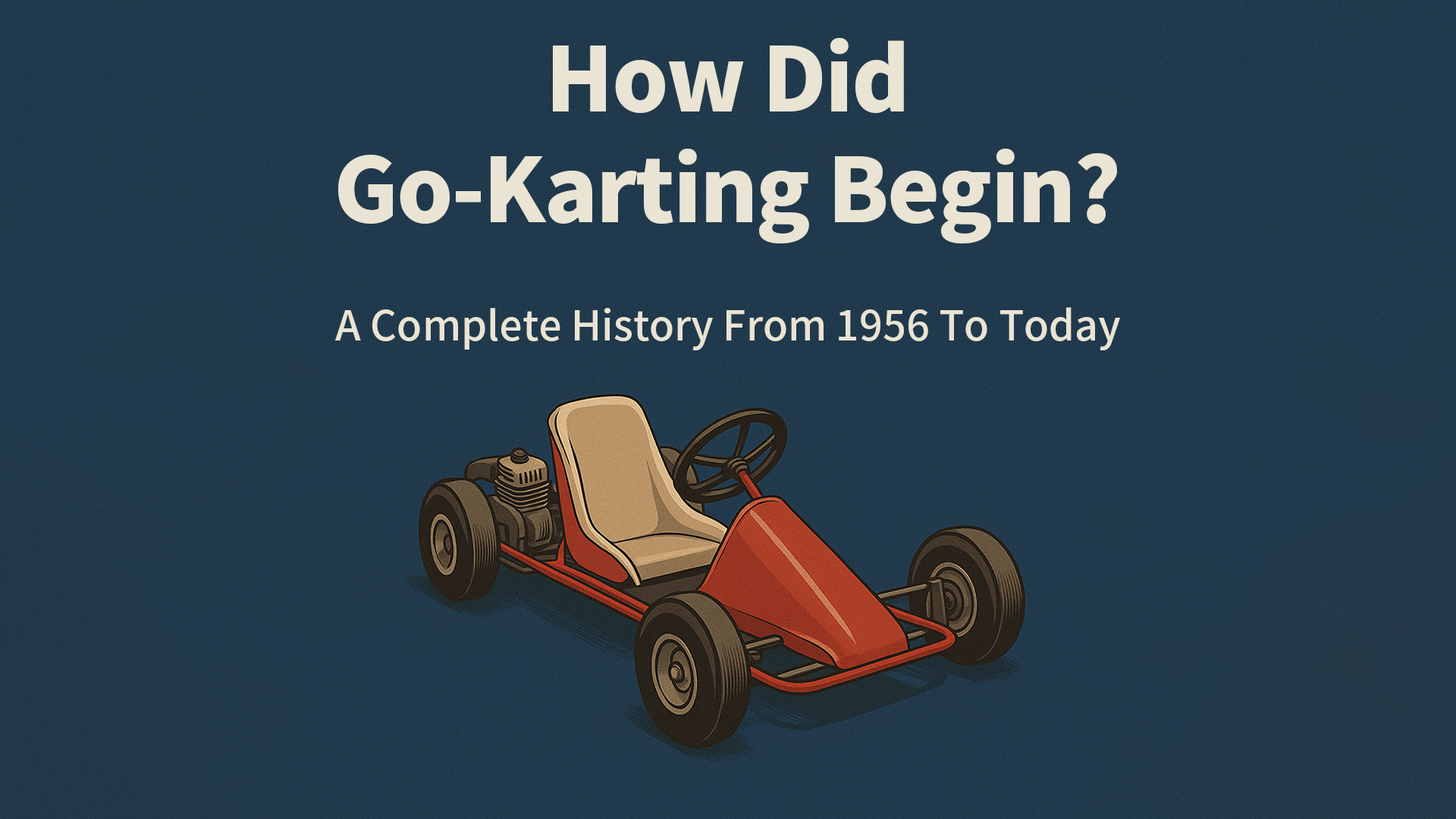
1. The Origin Story: A Garage Build That Sparked a Sport (1956)
The modern go-kart is widely recognized to have been born in 1956 in Southern California. Art Ingels, a race-car fabricator at Kurtis Kraft, welded together a lightweight tube-steel chassis using scrap material and installed a small two-stroke West Bend engine supplied by Lou Borelli. Ingels tested the machine in the Rose Bowl parking lot in Pasadena, and the public response was immediate: people gathered, asked questions, and soon began building their own versions. Karting, as a movement, started right there—hands-on, grassroots, and driven by curiosity.
This first era established two defining traits of karting:
-
Low barrier to entry: small engines and compact frames made real racing feel achievable outside professional circles.
-
Pure driving feedback: low weight and short wheelbase created a sharp, direct connection between driver input and vehicle response.
Karting did not begin as a commercial product. It began as a maker’s solution to experiencing racing in a simpler, cheaper form.
2. Grassroots Explosion and Early Industry (1957–Early 1960s)
After the first karts drew attention, the U.S. scene grew fast through weekend races and informal clubs. Parking lots and temporary circuits turned into local proving grounds. As demand increased, cottage builders became proper manufacturers.
In the late 1950s and early 1960s, engine suppliers such as McCulloch, West Bend, Clinton, and Power Products began producing dedicated kart powerplants. The two-stroke engine quickly became the standard because it offered high power-to-weight and mechanical simplicity—perfect for hobbyists and racers alike.
This period matters because karting became:
a shared platform for both racing and engineering experimentation.
Even in its earliest commercial stage, karting remained closely linked to customization and hands-on improvement.
3. International Organization: FIA/CIK and World-Level Racing (1962–1970s)
Karting’s popularity spread quickly to Europe, and with scale came the need for structure.
-
In 1962, the FIA (Fédération Internationale de l’Automobile) formed the CIK (Commission Internationale de Karting), formally placing karting under international motorsport governance.
-
By 1964, the first CIK-FIA Karting World Championship launched, establishing a top-tier competitive ladder that continues today under FIA Karting.
Standardized rules for chassis construction, engine displacement, weight, tires, and safety turned karting into a true global sport. Europe also emerged as a long-term technical center for elite kart engineering and racing culture.
4. Technical Progress and Class Structure (1980s–2000s)
From the 1980s onward, karting matured into a layered ecosystem serving different performance goals:
Direct-Drive Karts
Direct-drive classes emphasize minimal drivetrain loss, lightweight handling, and clean throttle response. International rules evolved through categories like ICA and KF into today’s elite OK and OK-Junior classes.
Gearbox Karts
Gearbox (shifter) karts pushed speeds higher and introduced multi-gear racecraft closer to full-size motorsport. These classes stabilized into KZ and KZ2, built around 125cc engines and multi-speed transmissions.
Youth Development
By the 1990s and 2000s, junior classes became a structured pipeline worldwide. Karting cemented its role as motorsport’s “first step,” with countless professional drivers beginning here.
5. Modern Karting: Elite Racing and Retail-Driven Recreation (2010s–Today)
Karting today runs on two connected tracks:
1 Competitive Karting
FIA Karting governs the world’s top categories—OK / OK-Junior, KZ / KZ2, and academy-style ladders for driver development. These classes evolve with strict technical and safety standards.
2 Recreational Karting
At the same time, arrive-and-drive rental karting has expanded worldwide, and the FIA has even launched programs to encourage this accessible format as a feeder into organized competition.
Recreational karting keeps the original 1950s spirit alive: you can show up, drive fast, and fall in love with racing without needing a garage full of tools.
6. Karting in the U.S. Today: Why DIY and Early Adopters Are Driving the Next Wave
In the United States, karting is growing in both the retail ownership and the experience economy. Three trends stand out:
-
The rise of electric karting
Electric karts are gaining traction across indoor venues and consumer retail. Market reports show strong growth fueled by demand for cleaner, quieter, and lower-maintenance performance.
-
Indoor tracks and urban karting expansion
Indoor karting—especially electric—has expanded quickly, supported by compact track design and consumer interest in high-tech recreation. This growth is visible in new venues and in market forecasts for indoor/electric segments.
-
A stronger retail/DIY culture around karts
Beyond rentals, more U.S. enthusiasts are buying karts for personal use, upgrading components, and experimenting with setups—mirroring the sport’s original maker roots. The broader go-kart market (including consumer purchases) continues to expand, with electric and customization-friendly models becoming increasingly common.
For DIY-minded customers, karting is uniquely attractive because it sits at the intersection of:
-
mechanical creativity (tuning, gearing, tires, chassis setup)
-
new technology adoption (electric power, telemetry, modular upgrades)
-
instant feedback (every change shows up in lap time and feel)
In other words: karting rewards people who love building, testing, and improving.
7. What This History Means for Today’s Drivers
-
Karting’s core value never changed: it delivers the most direct driving feedback in motorsport.
-
Racing and recreation share the same DNA: competition pushes limits; mainstream karting grows culture and access.
-
Understanding the roots helps you choose your path: whether you want a DIY performance project or a gateway to organized racing, karting offers a proven lane.
Closing Thoughts
The first kart in 1956 was not designed by a corporation—it was built by a racer-fabricator experimenting in a garage. That spirit still defines karting today. Whether you’re tuning your own setup, experimenting with electric power, or chasing your next personal-best lap, you’re part of a tradition that has always belonged to people who love speed and love building things.
Ready to Start Your Own Karting Build?
If you’re the kind of driver who enjoys learning by doing—upgrading parts, experimenting with setups, and getting hands-on performance—karting is one of the most rewarding hobbies you can enter.
At LONGWISE, we focus on retail karting solutions for builders and early adopters: karts, components, and practical guidance to help you get from “first build” to confident driving.
Explore our products, or reach out if you want help choosing a platform that fits your goals.